


Pull up any work order from the last six months. You'll see a date, an asset number, a failure code, and maybe a one-line description: "Replaced bearing on conveyor 7." What you won't see is why that bearing failed, what the technician checked first, or what they ruled out before pulling it apart.
That gap between what your CMMS records and what your team actually knows is the most expensive blind spot in maintenance operations.
Fifteen Years of Data, Zero Diagnostic Value
Most plants we walk into have enormous CMMS databases. Hundreds of thousands of work orders spanning a decade or more. On paper, that looks like a gold mine, but in practice, it's a filing cabinet full of receipts. You know what was replaced and when. You rarely know the reasoning behind the repair.
The reason is straightforward. CMMS platforms are systems of record. They were built to track work orders, schedule PMs, manage parts inventory, and generate compliance reports. They do those things well. What they were never designed to do is capture diagnostic reasoning: the sequence of checks a technician ran, the symptoms they observed, the hypotheses they tested and discarded before arriving at a root cause.
A typical work order entry looks like: "Motor tripping on overload. Replaced contactor." But the actual diagnostic process, the part that took 45 minutes of schematic tracing and relay testing, lives entirely in the technician's head.
The Real Cost of Missing Context
Here's where it gets expensive. When that same motor trips again three months later, the next technician starts from zero. They don't know the contactor was already replaced. They don't know the original technician suspected a downstream ground fault but ran out of time to trace it. They don't have access to the reasoning that would have pointed them toward the actual root cause on the first visit.
We see this pattern at every plant we work with. At one Tier 1 automotive facility, a recurring fault on a robotic welding cell generated 14 work orders over 18 months. Each one was logged as a separate event. Each technician approached it fresh. The actual root cause, a marginal connection in the safety circuit, was something a 30-year veteran had suspected months earlier but never documented because there was nowhere meaningful to put that information. By the time the issue was finally resolved, the plant had absorbed over $500K in downtime costs and one misdiagnosis that nearly sent them down the wrong path entirely.
That's the math on missing context. The information existed, but it just lived in someone's memory instead of somewhere the next person could find it.
Why Free-Text Notes Fall Short
Some plants try to solve this by encouraging technicians to write detailed notes in the CMMS. The intention is good, but the results are mixed at best.
Free-text maintenance notes are inconsistent by nature. One technician writes three paragraphs. The next writes "fixed." Terminology varies. Abbreviations are personal. And critically, nobody reads them. When a breakdown hits, the technician standing in front of the machine needs an answer in minutes. Scrolling through years of unstructured notes in a CMMS interface is the last thing they're going to do.
The problem is structural. CMMS platforms organize information by work order, by date, by asset. Diagnostic reasoning cuts across all of those dimensions. Understanding why a piece of equipment fails requires connecting symptoms, historical patterns, electrical schematics, OEM documentation, and the accumulated judgment of everyone who has ever worked on that asset. A flat database of work order records was never going to deliver that.
The Difference Between Recording and Reasoning
The distinction matters because it shapes what's possible. A system that records events can tell you what happened, but a system that captures and builds on diagnostic reasoning can tell you what to check first, what similar failures looked like, and which root causes are most probable given the symptoms you're seeing right now.
Root cause analysis in manufacturing has traditionally been a people-dependent process. The best maintenance teams have senior technicians who carry mental models of every critical asset in the plant. They know that when conveyor 12 throws a specific fault code during summer months, it's usually thermal expansion in the drive coupling, because they've seen it four times over fifteen years. That knowledge is extraordinarily valuable, but also extraordinarily fragile.
When those technicians retire, and roughly half of manufacturing's skilled workforce will reach retirement age by 2030, the reasoning goes with them. The CMMS stays behind with its tidy rows of dates and failure codes, and the new technician is left to figure it out from scratch.
What Becomes Possible When You Close the Gap
The plants that are getting ahead of this problem are the ones recognizing that maintenance data analysis requires more than a better reporting dashboard. It requires a fundamentally different approach to how diagnostic knowledge is captured, structured, and made available at the point of work.
That means building systems that can reason over the full picture: work history, schematics, OEM documentation, failure patterns, and the accumulated insights of every technician who has touched that asset. AI Diagnostic Agents are emerging to fill exactly this gap, sitting alongside the CMMS as a system of intelligence rather than just a system of record.
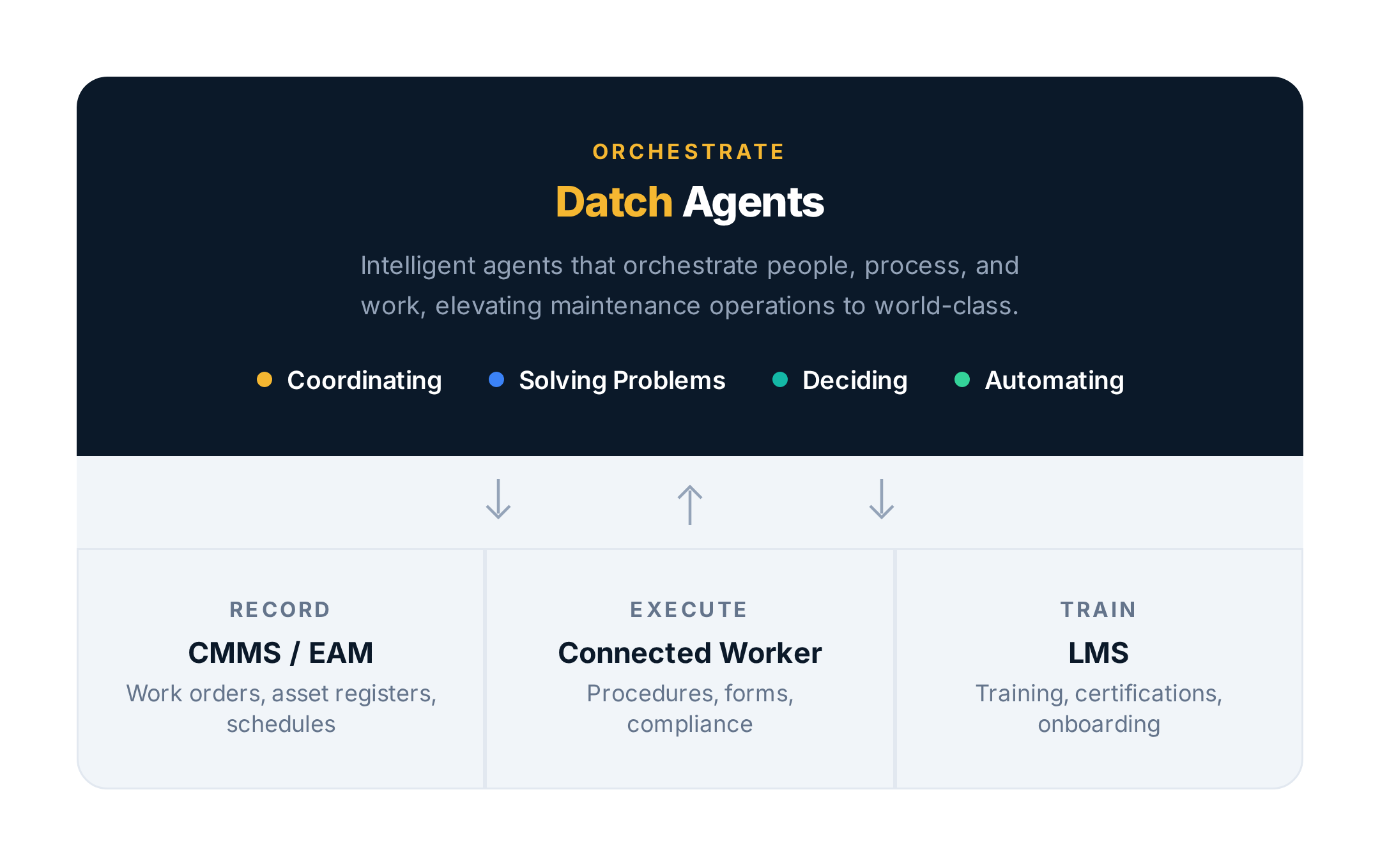
The CMMS will always have a role. It's the backbone of maintenance workflow management, and it should be. But the next time someone tells you they have "fifteen years of maintenance data," ask them one question: can your newest technician use any of it to fix something faster?
If the answer involves calling the retired guy, you've found the gap.
What’s a Rich Text element?
The rich text element allows you to create and format headings, paragraphs, blockquotes, images, and video all in one place instead of having to add and format them individually. Just double-click and easily create content.
What’s a Rich Text element?
The rich text element allows you to create and format headings, paragraphs, blockquotes, images, and video all in one place instead of having to add and format them individually. Just double-click and easily create content.
What’s a Rich Text element?
The rich text element allows you to create and format headings, paragraphs, blockquotes, images, and video all in one place instead of having to add and format them individually. Just double-click and easily create content.
What’s a Rich Text element?
The rich text element allows you to create and format headings, paragraphs, blockquotes, images, and video all in one place instead of having to add and format them individually. Just double-click and easily create content.
What’s a Rich Text element?
The rich text element allows you to create and format headings, paragraphs, blockquotes, images, and video all in one place instead of having to add and format them individually. Just double-click and easily create content.
What’s a Rich Text element?
The rich text element allows you to create and format headings, paragraphs, blockquotes, images, and video all in one place instead of having to add and format them individually. Just double-click and easily create content.

The rich text element allows you to create and format headings, paragraphs, blockquotes, images, and video all in one place instead of having to add and format them individually. Just double-click and easily create content.
- List item one
- List item two
- List item three
The rich text element allows you to create and format headings, paragraphs, blockquotes, images, and video all in one place instead of having to add and format them individually. Just double-click and easily create content.
- List item one
- List item two
- List item three
The rich text element allows you to create and format headings, paragraphs, blockquotes, images, and video all in one place instead of having to add and format them individually. Just double-click and easily create content.
This is a quote.
The rich text element allows you to create and format headings, paragraphs, blockquotes, images, and video all in one place instead of having to add and format them individually. Just double-click and easily create content.
The information existed, but it just lived in someone's memory instead of somewhere the next person could find it.


